Sheffield Poverty Truth Commission
Poverty Proofing
Following the findings of the Sheffield Poverty Truth Commission in October 2025, Learn Sheffield will run a poverty proofing pilot, in partnership with Children North East. The pilot is designed to help schools adapt in order to identify structural inequalities. The desired outcomes are:
- Greater poverty awareness
- Improved engagement
- Improved health and wellbeing
- Improved educational outcomes
Phase 1 will be run in pairs of settings (one primary, one secondary) in different geographical areas of the city. These locations will include at least one low-income community and at least one more affluent community. This will be completed by the end of 2026. A small group of professionals will be trained to conduct poverty proofing audits in year 1, with an expansion of the team in years 2 and 3.
The work on poverty proofing will align with other work being undertaken in response to the Poverty Truth Commission and we will engage with other partners (including public health, Save the Children, Roundabout) to ensure joined-up and collaborative working.
The pillars of Poverty Proofing are:
- VOICE: we recognise that to see real social change it is imperative that the voices of those affected by poverty are central to understanding and overcoming the barriers they face.
- PLACE: we need to understand the context of the community and place which we seek to ‘poverty proof’. We recognise that poverty impacts places differently, and so understanding place is vital in our response. Organisationally we also need to be clear about why and how decisions are made.
- STRUCTURAL INEQUALITIES: while tackling poverty can feel like an impossible and unachievable goal, the knowledge that the root causes of poverty are structural gives us reason for hope. Through the understanding of the lived experience of systems, policies, practices and assumptions, structural barriers at an organisational level can be eliminated.
Audits will follow a set structure. Stakeholders, including pupils, patients, community members and host organisation staff, are engaged through interviews, focus groups and surveys, along with briefings and training sessions. This process informs the production of a detailed audit that identifies institutional and cultural practices and behaviours that cause or enable barriers to access for people experiencing poverty.
The findings are then translated into a practical action plan, setting out achievable short‑ and long‑term actions to systematically remove these barriers. Delivery is supported by good‑practice guidance and ongoing advice from trained advisors.
If you are interested in finding out more about this work, please contact enquiries@learnsheffield.co.uk.
Sheffield Poverty Truth Commission 2024/25
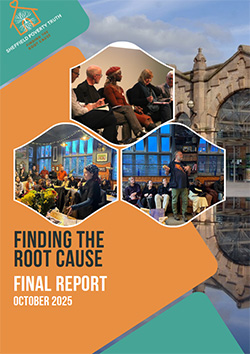
‘Finding the Root Cause’ – the Sheffield Poverty Truth Commission final report was published in October 2025.
This report provides a detailed account of the work and findings of Sheffield’s first Poverty Truth Commission, a community-led initiative aimed to address some of the root causes of poverty by centring the voices and experiences of those most directly affected.
The Commission focused its recommendations on a small number of cross-cutting themes and three priority areas, identified as being of crucial importance to tackling poverty in Sheffield:
- Early Years, Children & Young People
- Systemic Barriers within organisations or structures that perpetuate inequality
- Mental Health, recognising the complex interplay between psychological wellbeing and poverty.
These recommendations will now be picked up by partners, including Learn Sheffield to inform future work.
To find out more about poverty truth commissions, watch the short video below, read the briefing note below that or visit the website:
Video: https://vimeo.com/587890975
Poverty Truth Briefing Note
Poverty Truth Website